Sepia Saturday 493: Second in a new series on why my third great-grandmother Hannah (Hance) Blakeslee may have left her marriage in 1858.
In the quest to figure out why my third great-grandmother left her marriage in 1858, I examined what I have discovered so far about her early married life. On the surface, it appears unremarkable.
Sometime after the 1830 birth of their first child Rhoda Ann, my third great-grandparents Zebulon and Hannah (Hance) Blakeslee moved just across the border, from Lawsville in Susquehanna County, Penna., to Broome County, N.Y. — most likely settling in or near Hannah’s Conklin, N.Y., birthplace.
Susquehanna River valley where New York and Pennsylvania meet (1912). By 1850, my third great-grandmother Hanna, 38, had lived her entire life within a ten-mile radius of where she was born. If she had hopes that her Connecticut-born husband Zebulon might show her a wider world, they were not realized during their marriage. Yet was that enough reason to leave him? Image: powerlibrary.org
Their second daughter — my great-great grandmother Mary Elizabeth (Blakeslee) Bull — was born in Broome County in 1839 (according to Mary’s death certificate and her enumerations in the 1865 New York State1 FamilySearch requires free login to view records. and 1870 federal 2 FamilySearch requires free login to view records. censuses.). Hannah was then 27.
In 1846 Zebulon was appointed postmaster of Shawsville, Broome Co., N.Y., and by 1850 he and Hannah were living on a 80-acre Conklin, N.Y., farm. Their daughter Rhoda, 19, lived next door with her husband William Whitney, 31. Hannah was then 38, and her daughter Mary, 12, was still at home.
As she approached 40, my third great-grandmother Hannah had lived her entire life in a sparsely populated rural area within a ten-mile radius of where she was born. If she had hopes that her Connecticut-born husband Zebulon might show her a wider world, they were not realized during their marriage. Yet was that enough reason to leave him?
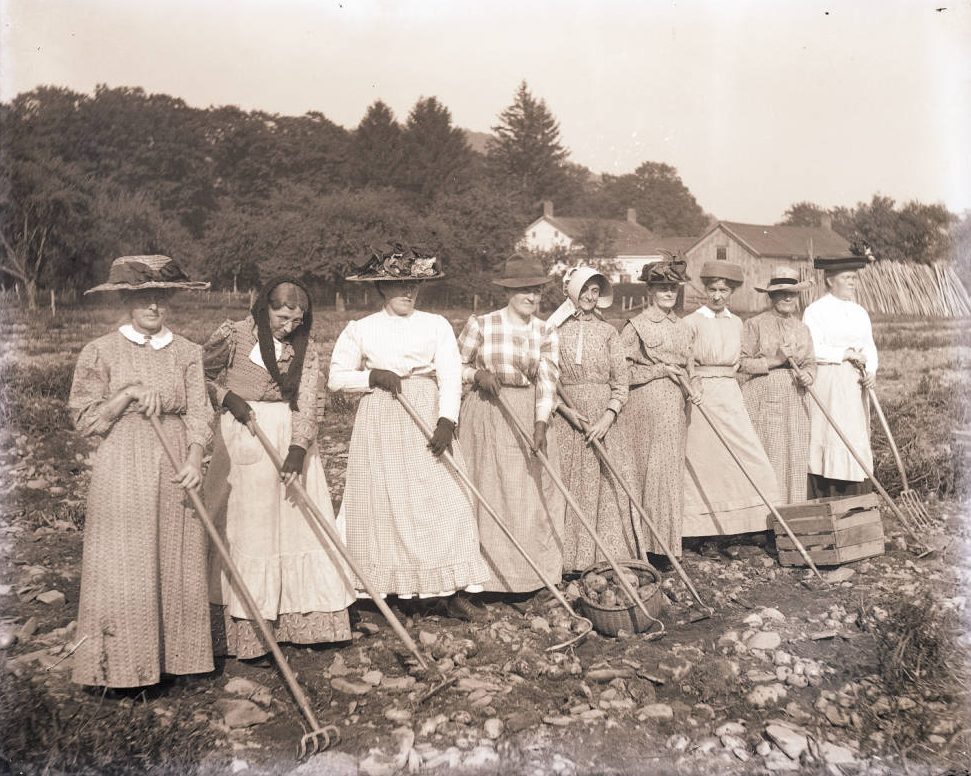
Nine women with rakes (circa 1890-1920). For women, the social aspects of farm labor may have helped compensate for its physicality. So the difficulties of farm life alone may not have been sufficient reason for Hannah (Hance) Blakeslee to leave her husband in 1858. Photo: Franck Taylor Bowers collection – Broome County Historical Society
Daily life on the farm
Wondering about Hannah’s daily life, my research led me to a scholarly paper about Pennsylvania agriculture circa 1800-1840, The paper contains an interesting passage, quoted below, about laboring on a farm in that period — which likely applied to nearby, cross-border New York farms as well.
Family and neighborhood labor dominated during this period. Men, women, and children all contributed work toward the family sustenance; there was a gender division of labor, but it was flexible. Men usually worked at lumbering, clearing land, building fence[s], and raising field crops, while women and children tended livestock, made dairy products, and preserved food.
But diarist Philip Fithian travelled in Lycoming County in the late eighteenth century and reported seeing even elite daughters milking and reaping, and George Dunklebarger, in his Story of Snyder County, claimed that “many of the women were as skilled with the sickle as were the men.”
Pennsylvania’s Historical Agricultural Regions. The Blakeslees began their married life in Susquehanna County’s northern tier grasslands –which extended north across the border into Conklin, Broome County, N.Y., where they later farmed in 1850. Source: phmc.state.pa.us
A history of Lycoming County remarked that during the early days “It was a common occurrence for a woman to walk fifteen miles or more, a great homemade basket filled with butter, eggs, and farm produce balanced on her head.” Everyone participated in maple sugaring and often in haying and harvesting too. “Bees” for sugaring, house raising, husking, and other jobs made work a social event.
Longtime readers of Molly’s Canopy will remember the 300 pounds of butter that were produced on the Blakeslee farm in 1850. According to the excerpt above, that output may well have been due to the hard work of Hannah and her daughters!
Not enough reason to leave
Yet if life on the farm was demanding in the mid-1800s, the challenge was also widely experienced by other rural women of the period. And the social aspects of the work — when small farming communities pitched in at harvest and other times — may have helped compensate for the physicality of the labor.
Thus the difficulties of farm life alone do not seem like reason enough for Hannah to leave her marriage, either. There must have been some other cause — perhaps some abrupt change — that prompted her departure.
Up next: Seeking clues in Hannah’s later married years.Meanwhile, please visit the blogs of this week’s other Sepia Saturday participants here.
14 thoughts on “1840-50: Hannah (Hance) Blakeslee’s early married years”
I’m new to Hannah’s story, and look forward to hearing more. I love the photo of the women with the rakes. Their hats!
Thanks, Kim. Yes, I am fond of the female farmers photo, too. We often see “housework” as the given occupation of female ancestors on censuses, etc. But women on family farms worked outside the home at all kinds of tasks.
I love reading about Hannah and her life. I wish she had kept a journal. I bet that would be a great read.
I bet it would, too!
I wish Hannah had kept a diary.
So do I!
Farm life was tough. The vigilance over the livestock and fields, the worry over the weather, and the stress over the family’s cash flow must have affected both men and women, though maybe to different degrees. But like Kristin said, churning 300 pounds of butter was not a reason to escape a marriage. If anything it was something to be proud of and probably contributed a sizable sum to the family’s income.
I still think money may have played a part in Hannah’s decision.
A current project of mine is digitizing a 1920s photo album of my mother’s grandmother’s farm in southeast Maryland. It was tobacco country and my mom tells tales of the hot work picking tobacco worms or hanging the sheaves to dry in the barn. When her grandfather died, his widow, my great grandmother, struggled to maintain the farm. Her eldest child, my great uncle, was forced to sell off the land and the story goes that he and a brother-in-law used the money to invest in some business venture that failed. It’s the kind of in-family dispute over property and money that I think might have happened between Zebulon and Hannah. Was it gambling? A bad business decision? Using the farm to back a high-interest loan?
Whatever it was, the questions have us all hooked on your family story because we have similar puzzles in our family trees.
Totally true: it’s the nagging questions that push our research forward. Starting with the elemental one: Who am I and where did I come from?
If Hannah was happy or at least comfortable with Zebulon and her marriage, I don’t think working hard would be enough to drive her away. The neighbors thought her husband treated her well although what that actually meant could be defined in a number of ways that wouldn’t actually divulge the full truth. Did they mean he didn’t seem to do her any physical harm? There could have been mental cruelty which the neighbors might not have been aware of. One has to remember people, when they are around other people, tend to be on their best behavior. I would think, back in that time, it would have to have been something really serious to induce Hannah to leave.
Many of these are questions I have asked myself. The neighbors likely only knew a part of Hannah and Zebulon’s story — mainly focused on outward evidence of the economics of their relationship (i.e., he was a good provider). Now, 160 years later, I’m trying to get to the heart of their story.
I don’t think it was making butter that drove Hannah away…
Me either!
I am enjoying reading your analysis on reasons behind Hannah leaving her husband, and look forward to the next post in your series. The isolation that came from hard physical farm work was certainly replicated here in my own area in the Scottish Borders – it must have been very limiting for many women who craved more from life.
I lived on a farm as a child, but there were roads and cars and lots of kids at school. Still, once I moved to the suburbs I realized how isolating farm life was by comparison — and it was likely more so in the mid 1800s.
We use cookies on our website to give you the most relevant experience by remembering your preferences and repeat visits. By clicking “Accept”, you consent to the use of ALL the cookies.
This website uses cookies to improve your experience while you navigate through the website. Out of these, the cookies that are categorized as necessary are stored on your browser as they are essential for the working of basic functionalities of the website. We also use third-party cookies that help us analyze and understand how you use this website. These cookies will be stored in your browser only with your consent. You also have the option to opt-out of these cookies. But opting out of some of these cookies may affect your browsing experience.
Necessary cookies are absolutely essential for the website to function properly. These cookies ensure basic functionalities and security features of the website, anonymously.
Cookie
Duration
Description
cookielawinfo-checkbox-analytics
11 months
This cookie is set by GDPR Cookie Consent plugin. The cookie is used to store the user consent for the cookies in the category "Analytics".
cookielawinfo-checkbox-functional
11 months
The cookie is set by GDPR cookie consent to record the user consent for the cookies in the category "Functional".
cookielawinfo-checkbox-necessary
11 months
This cookie is set by GDPR Cookie Consent plugin. The cookies is used to store the user consent for the cookies in the category "Necessary".
cookielawinfo-checkbox-others
11 months
This cookie is set by GDPR Cookie Consent plugin. The cookie is used to store the user consent for the cookies in the category "Other.
cookielawinfo-checkbox-performance
11 months
This cookie is set by GDPR Cookie Consent plugin. The cookie is used to store the user consent for the cookies in the category "Performance".
viewed_cookie_policy
11 months
The cookie is set by the GDPR Cookie Consent plugin and is used to store whether or not user has consented to the use of cookies. It does not store any personal data.
Functional cookies help to perform certain functionalities like sharing the content of the website on social media platforms, collect feedbacks, and other third-party features.
Performance cookies are used to understand and analyze the key performance indexes of the website which helps in delivering a better user experience for the visitors.
Analytical cookies are used to understand how visitors interact with the website. These cookies help provide information on metrics the number of visitors, bounce rate, traffic source, etc.
Advertisement cookies are used to provide visitors with relevant ads and marketing campaigns. These cookies track visitors across websites and collect information to provide customized ads.



I’m new to Hannah’s story, and look forward to hearing more. I love the photo of the women with the rakes. Their hats!
Thanks, Kim. Yes, I am fond of the female farmers photo, too. We often see “housework” as the given occupation of female ancestors on censuses, etc. But women on family farms worked outside the home at all kinds of tasks.
I love reading about Hannah and her life. I wish she had kept a journal. I bet that would be a great read.
I bet it would, too!
I wish Hannah had kept a diary.
So do I!
Farm life was tough. The vigilance over the livestock and fields, the worry over the weather, and the stress over the family’s cash flow must have affected both men and women, though maybe to different degrees. But like Kristin said, churning 300 pounds of butter was not a reason to escape a marriage. If anything it was something to be proud of and probably contributed a sizable sum to the family’s income.
I still think money may have played a part in Hannah’s decision.
A current project of mine is digitizing a 1920s photo album of my mother’s grandmother’s farm in southeast Maryland. It was tobacco country and my mom tells tales of the hot work picking tobacco worms or hanging the sheaves to dry in the barn. When her grandfather died, his widow, my great grandmother, struggled to maintain the farm. Her eldest child, my great uncle, was forced to sell off the land and the story goes that he and a brother-in-law used the money to invest in some business venture that failed. It’s the kind of in-family dispute over property and money that I think might have happened between Zebulon and Hannah. Was it gambling? A bad business decision? Using the farm to back a high-interest loan?
Whatever it was, the questions have us all hooked on your family story because we have similar puzzles in our family trees.
Totally true: it’s the nagging questions that push our research forward. Starting with the elemental one: Who am I and where did I come from?
If Hannah was happy or at least comfortable with Zebulon and her marriage, I don’t think working hard would be enough to drive her away. The neighbors thought her husband treated her well although what that actually meant could be defined in a number of ways that wouldn’t actually divulge the full truth. Did they mean he didn’t seem to do her any physical harm? There could have been mental cruelty which the neighbors might not have been aware of. One has to remember people, when they are around other people, tend to be on their best behavior. I would think, back in that time, it would have to have been something really serious to induce Hannah to leave.
Many of these are questions I have asked myself. The neighbors likely only knew a part of Hannah and Zebulon’s story — mainly focused on outward evidence of the economics of their relationship (i.e., he was a good provider). Now, 160 years later, I’m trying to get to the heart of their story.
I don’t think it was making butter that drove Hannah away…
Me either!
I am enjoying reading your analysis on reasons behind Hannah leaving her husband, and look forward to the next post in your series. The isolation that came from hard physical farm work was certainly replicated here in my own area in the Scottish Borders – it must have been very limiting for many women who craved more from life.
I lived on a farm as a child, but there were roads and cars and lots of kids at school. Still, once I moved to the suburbs I realized how isolating farm life was by comparison — and it was likely more so in the mid 1800s.