

Sepia Saturday 526. Fourth in a series about Albert Barney Charboneau — my paternal grandfather’s brother who died in the Great Influenza Pandemic of 1918.

My dad’s Uncle Albert — who died in the 1918 influenza epidemic — moved to Dolgeville in New York’s Mohawk Valley in 1908 as a young adult, along with his parents and three brothers.
Compared to their Adirondack hometown of Hawkinsville, N.Y. , the family must have felt like they had arrived in the big city.
Such was the level of industry in Dolgeville that by the time of the 1910 federal census, Albert and his brothers were all gainfully employed — and would soon set up households of their own.
So it’s worth pausing the family story to examine how the once-rural town they now called home came to be bustling with enterprise — as ably described by Eleanor Franz in her book Dolge 1 Franz, Eleanor. Dolge. (Herkimer, New York: Herkimer County Historical Society, 1980). and summarized in brief below.

Early history of Brockett’s Bridge
When Alfred Dolge arrived in 1874, the town that would later bear his name was a small rural hamlet called Brockett’s Bridge. 2 Franz, Dolge, 3-4. However, the town with its landmark covered bridge, which appears right on the map above, was already steeped in history.
To indigenous inhabitants, the waterway that ran through the village was known as the Tegahuhharoughwe or Auskarada — the stream of many fishes. 3 Franz, Dolge, 3. Alas, by the late 1700s the Native guardians of the land were displaced by settlers moving west from New England, who mainly took up farming.
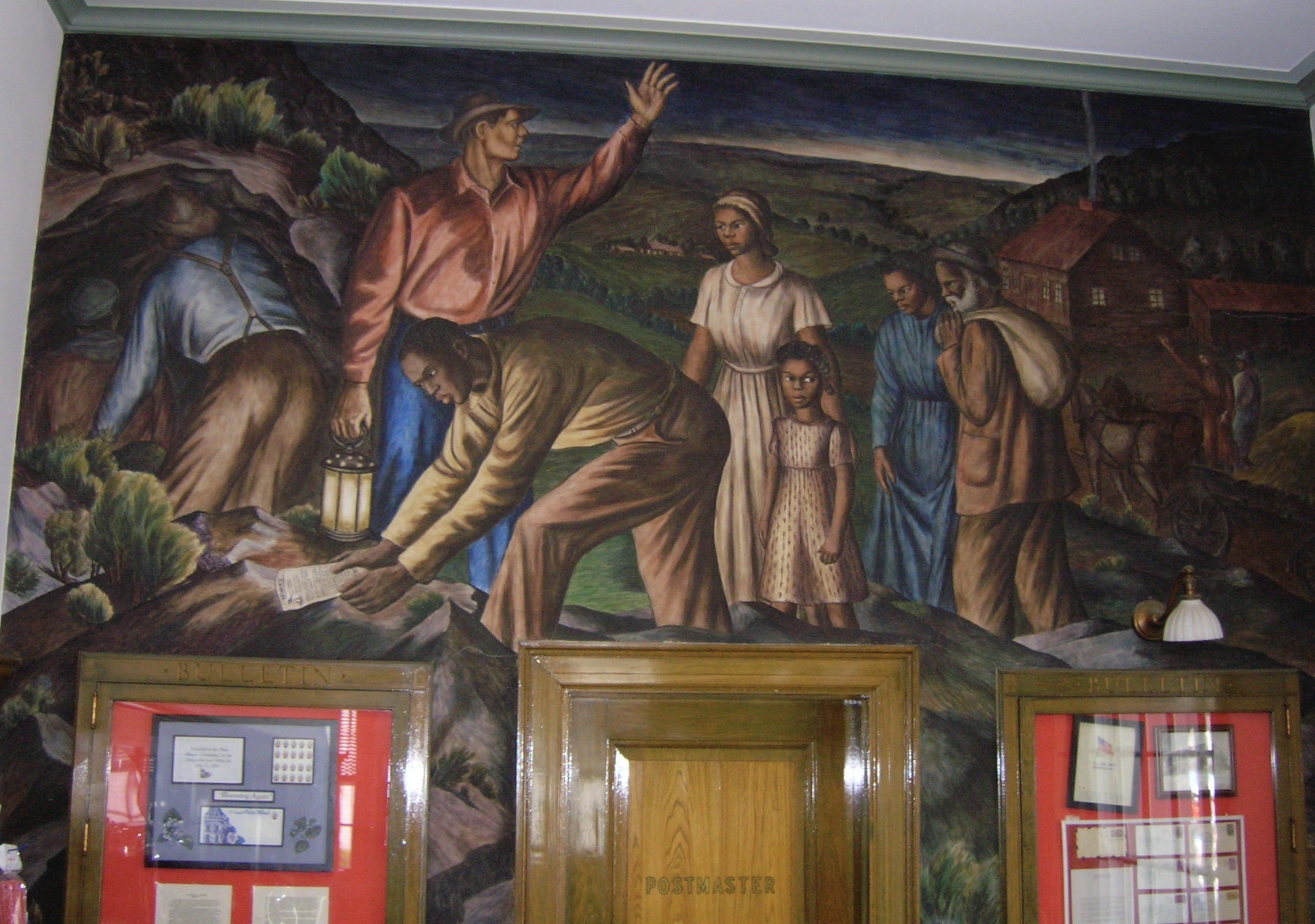
Later, in the period leading up to the U.S. Civil War, a free church in Brockett’s Bridge became a stop on the Underground Railroad — as depicted in the mural above — offering refuge to African-Americans who had liberated themselves from slavery and were making their way to freedom.
Enter piano maker Alfred Dolge
A tannery had also once hummed away in Brockett’s Bridge, but closed in 1871. 4 Franz, Dolge, 4. After that, the small village of about 300 might have declined but for the April 1874 arrival of Alfred Dolge — an immigrant from Germany’s Saxony region — who was looking for a place to manufacture felt for use in piano making. 5 ibid., 3.

On a fateful return trip to his New York City office from the Adirondacks — where he had traveled to buy wood for piano sounding boards — Dolge stopped off in Brockett’s Bridge and was immediately taken with its manufacturing potential. 6 Franz, Dolge, 5.
With plentiful water to provide power, nearby forests to supply wood and a vacant tannery ready for occupancy — not to mention the area’s striking resemblance to his native Saxony — Brockett’s Bridge appeared to be the ideal location for the enterprise Dolge had in mind. 7 ibid.
Ten days later he bought the old tannery building — a move that changed the life of his family and my own. 8 Franz, Dolge, 12.
More on this in the next post. Please stop back! Meanwhile, please visit the blogs of this week’s other Sepia Saturday participants here.
© 2020 Molly Charboneau. All rights reserved.