
Sepia Saturday 543. Fourteenth in a series about Albert Barney Charboneau — my paternal grandfather’s brother who died in the Great Influenza Pandemic of 1918.

The first time I called the Little Falls, N.Y., public library in April 2006 looking for the obituary of my dad’s Uncle Albert Barney Charboneau, I did not know his exact date of death.
I only knew the year, 1918 — when Uncle Albert died in Dolgeville, N.Y., in the Great Influenza Epidemic — most likely in the fall.
“That’s going to be a problem,” the librarian said. “Papers weren’t published during the flu pandemic for fear of spreading it by circulating the paper, so there may not be an obituary, but we’ll check.”
Some newspapers stopped publishing
Wow, no papers published? That’s when I first realized just how severely the 1918 influenza had hit in Herkimer County.
Later, the librarian called me back to say she was unable to find Uncle Albert’s obituary in 1918. “But I did find one article that said 15-25 people died per day between October and December 2018,” she said. “Do you want me to send it?”

Apparently some papers were published after all! So I said yes, hoping to learn more about the influenza’s impact in the Mohawk Valley — which would help me put Albert’s death in perspective.
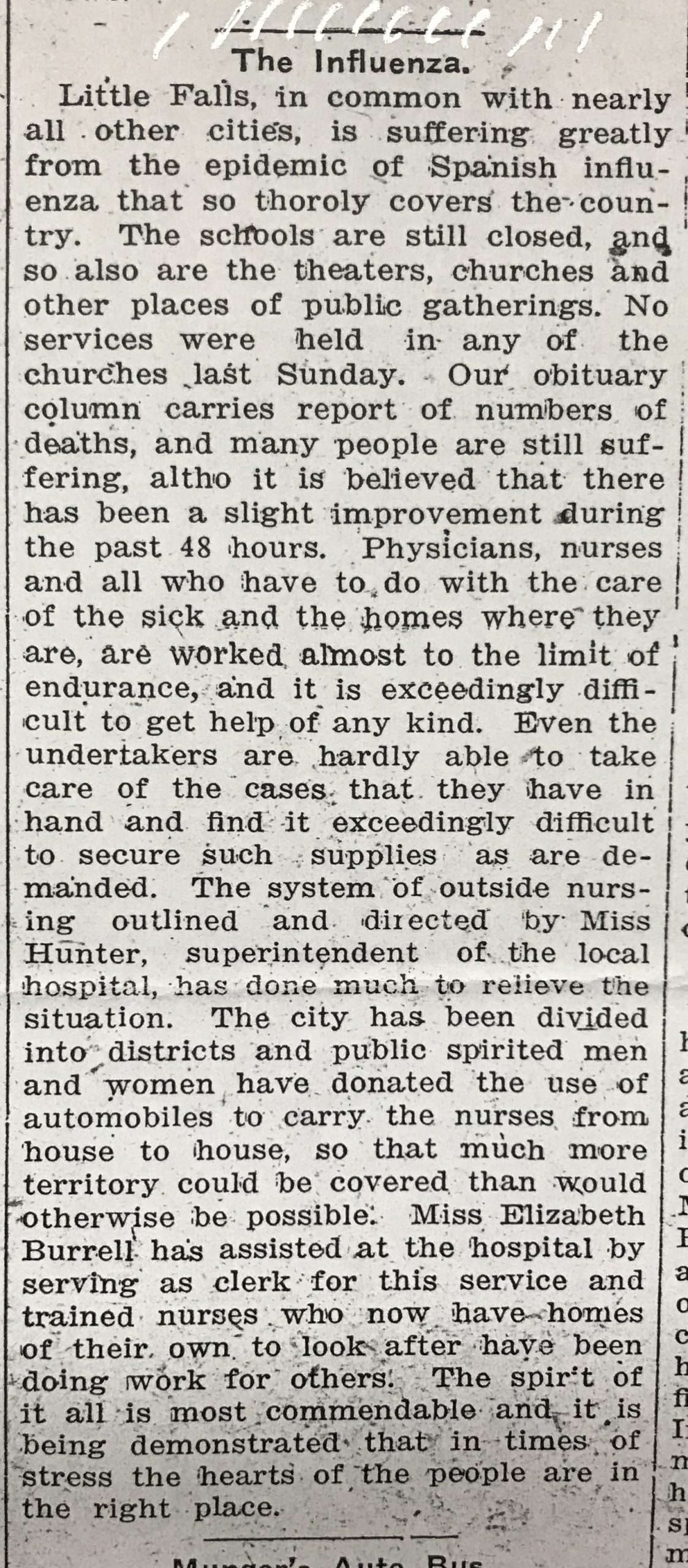
The article she sent, from the 15 Oct. 2018 issue of the Little Falls Journal and Courier, is a chilling summary of the influenza’s sweep through Little Falls — just south of Uncle Albert’s Dolgeville hometown and where his brother Uncle Dewey lived.
Health staff “worked almost to the limit of endurance”
The article (transcribed below) did not include a death toll. Yet it sounds sadly familiar as we continue to grapple with the coronavirus pandemic — closed schools and gathering places, no church services, numerous deaths and a terrific burden on frontline healthcare staff.
Little Falls, in common with nearly all other cities, is suffering greatly from the epidemic of Spanish [1918] influenza that so thoroughly covers the country. The schools are still closed, and so also are the theaters, churches and other places of public gatherings. No services were held in any of our churches last Sunday. Our obituary column carries report of numbers of deaths, and many people are still suffering, although it is believed that there has been a slight improvement during the past 48 hours.

Physicians, nurses and all who have to do with the care of the sick and the homes where they are, are worked almost to the limit of endurance, and it is exceedingly difficult to get help of any kind. Even the undertakers are hardly able to take care of the cases they they have in hand and find it exceedingly difficult to secure such supplies as are demanded.
“The hearts of the people are in the right place”
The article goes on to describe the emergency house-to-house nursing care provided in Little Falls — back when health care professionals still made house calls.
The system of outside nursing outlined and directed by Miss Hunter, superintendent of the local hospital, has done much to relieve the situation. The city has been divided into districts and public spirited men and women have donated the use of automobiles to carry the nurses from house to house, so that much more territory could be covered than would otherwise be possible.
Miss Elizabeth Burrell has assisted at the hospital by serving as clerk for this service and trained nurses who now have homes of their own to look after have been doing work for others. The spirit of it all is most commendable and it’s being demonstrated that in times of stress the hearts of the people are in the right place.
All around the article are columns of obituaries for those who died in the Little Falls, N.Y. area from the 1918 influenza and/or the pneumonia that followed in its wake.
Learning Uncle Albert’s story
But what about Uncle Albert’s experience?
Eventually, in the New York State Death Index, I was able to find his date of death — 23 Oct. 1918, just after the influenza’s peak in the U.S. Army. 1 Crosby, Alfred W. America’s Forgotten Pandemic: The Influenza of 1918 (Cambridge: Cambridge University Press, 2003), 59.
So when I called the Little Falls library a second time, they were able to locate Uncle Albert’s obituary chronicling his final days.
Up next: The final days of Albert Barney Charboneau. Meanwhile, please visit the blogs of this week’s other Sepia Saturday participants here.
© 2020 Molly Charboneau. All rights reserved.