
Sepia Saturday 557. Ninth in a series on my maternal German ancestors, the Stoutners, of Gloversville, Fulton Co., N.Y.

When they marriage, around 1866, my maternal German immigrant great-great grandparents Andrew Stoutner, 34, and Christina Albeitz, 22, created the blended Stoutner family of Gloversville, N.Y.
They began their life together as co-parents of Mary E. Stoutner, 5, and William Stoutner, 2 – Andrew’s children with his second wife Elizabeth D. Stoutner, who died in 1865.

And by 1867, Christina was pregnant with their first child together – a daughter Rose, born 20 Feb. 1868.
A promising beginning
I try to imagine my great-great grandparents’ first two married years. Presumably, it was a time of healing and renewal for widower Andrew and his children with Christina joining the household as a new wife and stepmother.
For recently-arrived Christina, Andrew and the children likely provided her with a sense of belonging as she adjusted to her new life in the U.S. And soon she and Andrew were expecting a new addition to their blended family — a promising beginning.

Illness casts a shadow
Yet life was precarious for infants and children in the nineteenth century. There were no vaccines for infectious diseases — and pre- and post-natal care were not what they are today. According to one source 1 Field MJ, Behrman RE, editors. When Children Die: Improving Palliative and End-of-Life Care for Children and Their Families. Institute of Medicine (US) Committee on Palliative and End-of-Life Care for Children and Their Families; Washington (DC): National Academies Press (US); 2003.:
In 1900, 30 percent of all deaths in the United States occurred in children less than 5 years of age…pneumonia and influenza, tuberculosis, and enteritis with diarrhea were the three leading causes of death in the United States, and children under 5 accounted for 40 percent of all deaths from these infections.
Tragedy in the Stoutner household
Nor were illnesses tracked in the 1800s they way they are today by state departments of health, the U.S. Centers for Disease Control and the World Health Organization.
Every birth in the 1800s came with hidden dangers — both for the mother during her pregnancy and before/after delivery, and for the child in its first years of life.
Sadly, the Stoutner family was not immune to these risks. On 18 October 1868, little Rose Stoutner died at 7 months of age — her dates engraved on her tombstone in Prospect Hill Cemetery, Gloversville, N.Y.
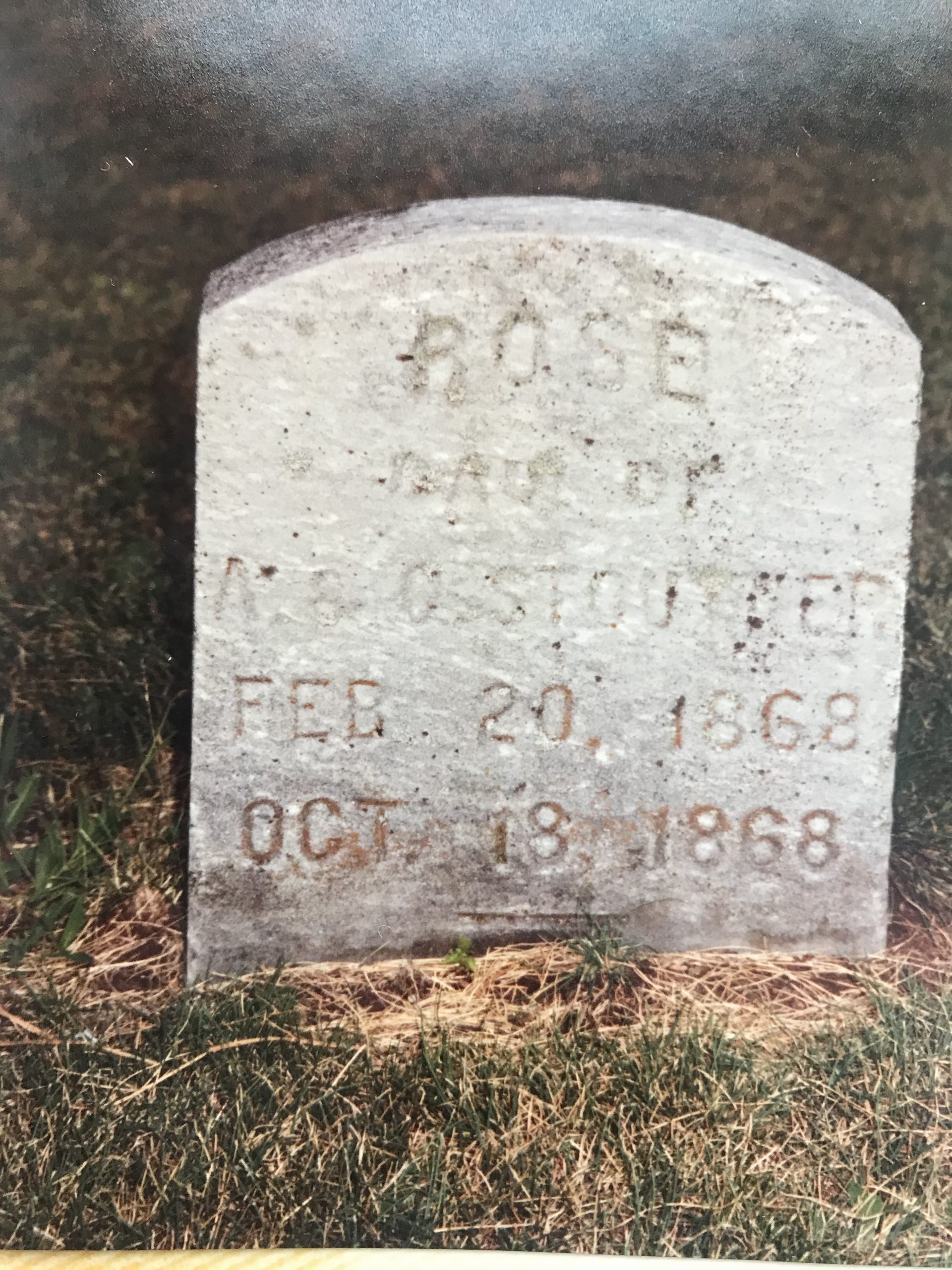
New York State did not begin compiling death records until June 1880, so Rose’s exact cause of death is unknown. She may have succumbed to one of the illnesses that claimed so many infants at the time — or she may simply have started out poorly and failed to thrive.
Whatever the cause, Rose’s death undoubtedly cast a pall over the Stoutner family — and Christina joined Andrew and the children in mourning the heartbreaking loss.
Up next: Happier days with baby John Stoutner. Please stop back! Meanwhile, please visit the blogs of this week’s other Sepia Saturday participants here.
© 2021 Molly Charboneau. All rights reserved.